


Why Are Nearly 80% of Prohibited CDL Drivers Not Starting the Return-to-Duty Process?

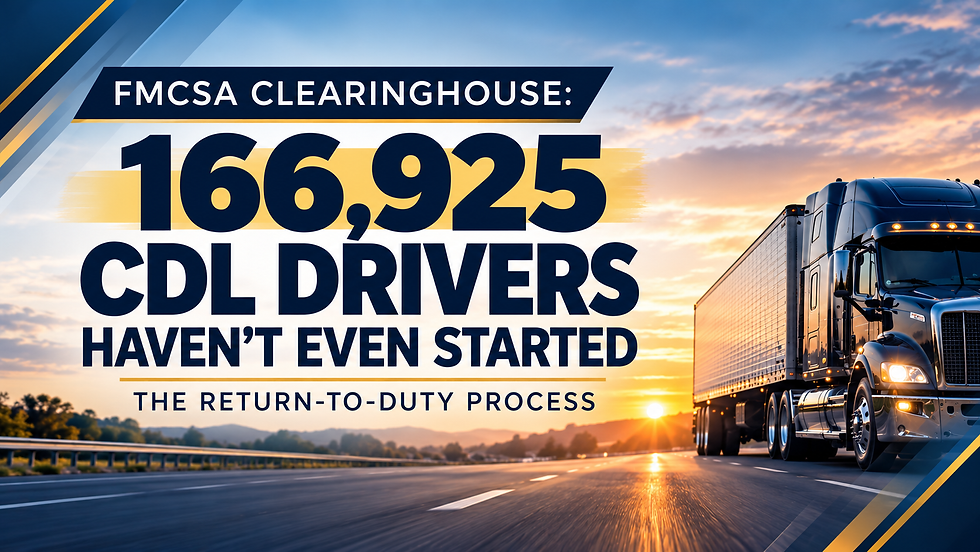
The latest FMCSA Drug and Alcohol Clearinghouse numbers reveal a major challenge facing the trucking industry: 210,007 CDL and CLP drivers were in Prohibited status as of February 1, 2026—and 166,925 of them had not started the Return-to-Duty process.
That means 79.5% of currently prohibited drivers had not taken the first steps toward becoming eligible to return to safety-sensitive work.
Why are so many CDL drivers not getting started?
That was the question I recently sat down to discuss with DOT-qualified Substance Abuse Professional (SAP) Graham Sargent of American River Wellness.
From my perspective as a C/TPA working directly with drivers through the Return-to-Duty process, and from Graham's perspective as a SAP conducting evaluations and helping drivers complete the first part of the process, we continue to see several common barriers: fear, misinformation, confusion about the Clearinghouse, concerns about employment after a violation, and simply not knowing what to do next.
The numbers are significant, but there is another side of the report that drivers should see:
119,176 drivers with violations were already in Not-Prohibited status.
In other words, thousands of drivers are getting through the process.
What Do the Latest FMCSA Clearinghouse Numbers Show?
According to FMCSA's January 2026 Clearinghouse Monthly Summary Report, there were 329,183 drivers with at least one recorded violation as of February 1, 2026.
Their current status broke down as follows:
Clearinghouse Status | Drivers |
Drivers with at least one violation | 329,183 |
Currently Prohibited | 210,007 |
Currently Not Prohibited | 119,176 |
RTD process not started | 166,925 |
RTD process started, not yet eligible for RTD testing | 19,361 |
Eligible for RTD test, test not completed | 23,721 |
Negative RTD test completed | 78,552 |
Follow-up testing plan complete | 40,624 |
Among drivers who remained prohibited, 79.5% had not started the RTD process, 9.2% had started but were not yet eligible for RTD testing, and 11.3% were eligible for their RTD test but had not completed it.
These figures are a snapshot as of February 1, 2026. FMCSA has also redesigned its monthly reporting process for 2026, including revised methods for extracting and processing Clearinghouse data.
Why Haven't 166,925 Prohibited Drivers Started the RTD Process?
The FMCSA report tells us how many drivers have not started. It does not tell us why.
That distinction is important.
However, Graham and I work with drivers dealing with Clearinghouse violations regularly, and we see several recurring issues in our own work.
Graham described his reaction to the 166,925 figure this way:
“It bummed me out a little bit... I think that accounts for a lot of people that are scared to move forward and figure out how to fix the problem.” He also pointed to misinformation and fear about whether a driver will ever be able to find work again after a violation.
In my experience, lack of knowledge is one of the biggest barriers.
Some drivers don't understand that there is a process for getting to the other side of a Clearinghouse violation. Others have heard so many negative stories online that they assume their trucking career is automatically over.
That isn't what we're seeing every day.
We continue to hear from drivers who have completed the required process and found employers willing to hire them.
That does not mean every employer will hire a driver with a previous Clearinghouse violation. Employment opportunities can depend on experience, location, company hiring policies, insurance requirements and other factors.
But assuming that no one will hire you can prevent you from ever taking the first step.
Start by Looking at Your Own Clearinghouse Record
One of Graham's observations during our conversation was surprisingly basic: some drivers who call him don't actually know what their Clearinghouse record says.
He explained that he sometimes asks a driver about the violation and hears:
“Well, I don't know.”
When he asks what appears in the driver's Clearinghouse account, some drivers don't know how to log in.
That's a problem because understanding your current record is one of the first things you should do before trying to determine your next move.
Graham's approach is straightforward:
“Let's start by having you log in there so you know what you're dealing with.”
Drivers can access their own Clearinghouse records. Before relying on information from a friend, another driver, a social media group or a random online post, look at your actual record.
Can You Get a Truck Driving Job After a Clearinghouse Violation?
A Clearinghouse violation does not necessarily mean you will never drive commercially again.
However, a driver with an unresolved violation is prohibited from performing DOT safety-sensitive functions.
Completing the required Return-to-Duty process changes the situation.
Graham explained during our discussion:
“You're definitely gonna have some barriers and there will be certain employers that won't be able to hire you, but there's gonna be plenty out there that will.”
He also emphasized something drivers need to hear: you may have to work harder to find the opportunity.
Your experience, location, type of driving you're willing to do, employer requirements and other factors can affect your options.
A driver looking only for one particular local job may have fewer opportunities than someone willing to consider different types of operations or locations.
There is no one-size-fits-all answer.
What Does “CDL Downgrade” Mean After a Clearinghouse Violation?
Another major source of confusion is the CDL downgrade requirement.
We continue to speak with drivers who receive a notice from their state driver's licensing agency and interpret the downgrade date as the date their CDL is permanently gone.
During our discussion, Graham described drivers calling him in a panic after receiving those notices.
The important takeaway is this:
A downgrade does not mean there is no path back.
Drivers should communicate directly with their State Driver Licensing Agency about the requirements for restoring their commercial driving privilege after they become eligible.
Requirements and administrative procedures can vary by state and depending on the driver's circumstances.
That is why I encourage drivers to contact their state licensing agency rather than assuming that another driver's experience in another state will apply to them.
What Are the Steps in the DOT Return-to-Duty Process?
FMCSA's current Clearinghouse overview identifies six milestones:
Step 1: SAP Request Sent
The driver selects a DOT-qualified Substance Abuse Professional and sends the SAP request through the Clearinghouse.
Step 2: SAP Designated
The SAP accepts the driver's request.
Step 3: Initial SAP Assessment Completed
The SAP conducts the initial evaluation and recommends the appropriate education and/or treatment.
Step 4: Driver Determined Eligible for RTD Testing
After the driver successfully complies with the SAP's recommendations and completes the follow-up evaluation, the SAP determines whether the driver is eligible for Return-to-Duty testing.
Step 5: Negative Return-to-Duty Test
The required Return-to-Duty test must produce a negative result before the driver can return to DOT safety-sensitive functions.
Step 6: Follow-Up Testing Plan Completed
After returning to safety-sensitive work, the driver must complete the follow-up testing plan prescribed by the SAP. The plan must include at least six unannounced follow-up tests during the first 12 months, although the SAP may require additional testing and a longer testing period.
Why Are 23,721 Drivers Eligible for RTD Testing but Still Prohibited?
This may be one of the most important numbers in the entire report.
23,721 drivers had already progressed far enough through the SAP process to become eligible for Return-to-Duty testing—but had not completed the RTD test.
These drivers have already started.
They have already worked with a SAP.
They have progressed through the first four Clearinghouse milestones.
Yet they remain prohibited.
Why?
Again, the FMCSA report does not tell us the individual reasons.
During our discussion, Graham suggested several possibilities based on situations he encounters, including lack of information, financial barriers, lack of follow-through and, in some cases, possible administrative issues.
He summarized the broader problem this way:
“I think the majority of the folks in both categories that we've covered here, it boils down to a lack of information on how to start or a lack of information on how to finish.”
That is an important distinction.
Some drivers need help starting.
Others need help understanding what comes next.
Who Can Send a Driver for the Return-to-Duty Test?
This is one area where drivers need to be particularly careful about the rules.
FMCSA's published driver guidance states that a DOT-regulated employer; not the employee,requests the official Return-to-Duty test. For an owner-operator, the designated C/TPA performs the employer functions required for the RTD process.
Drivers should therefore make sure their individual situation is being handled in accordance with current DOT and FMCSA requirements rather than assuming that any self-ordered drug test will satisfy Step 5.
A regular drug test is not automatically a DOT Return-to-Duty test.
Does a Clearinghouse Violation Automatically Disappear After Five Years?
No.
This is one of the most persistent Clearinghouse myths we hear.
Drivers sometimes tell us:
"I'm just going to wait five years and it'll fall off."
That is not how FMCSA describes the retention rule.
FMCSA states that violation information is retained in the Clearinghouse for five years from the date of the violation determination OR until the driver successfully completes the Return-to-Duty process and follow-up testing plan, whichever is later.
That last phrase, whichever is later, matters.
Graham has worked as a SAP since before the Clearinghouse launched and said he has encountered drivers with 2020 violations who waited years because they believed the record would simply disappear.
His message was direct:
“They wasted five years when they could have been done.”
Waiting is not a substitute for completing the required process.
Does Becoming “Not Prohibited” Mean Step 6 Is Finished?
No.
This is another distinction that causes confusion.
A driver becomes Not Prohibited after the required Return-to-Duty test produces a negative result and the required information is reported to the Clearinghouse.
But the driver's responsibilities do not necessarily end there.
The prescribed follow-up testing plan still must be completed.
FMCSA states that the follow-up testing plan must include at least six unannounced follow-up tests during the first 12 months after the driver returns to safety-sensitive functions. The SAP can require additional testing beyond that minimum.
The follow-up testing plan itself is not available to the driver through the Clearinghouse.
For company drivers, employers have important responsibilities for carrying out the prescribed follow-up testing. Owner-operators work through their designated C/TPA for applicable employer responsibilities.
Do Random Drug Tests Count as Follow-Up Tests?
Drivers should not assume that every DOT drug test they take is satisfying their SAP-prescribed follow-up testing requirements.
Random testing and SAP follow-up testing serve different regulatory purposes.
This is why communication between employers, C/TPAs and SAPs is so important.
Graham explained that he spends considerable time educating employers because the regulatory and administrative requirements can be unfamiliar:
“I spend almost just as much time educating employers every week as I do with clients.”
When required follow-up testing or reporting is not handled correctly, the person who may ultimately remain stuck in the process longer is the driver.
There Is Good News in the Clearinghouse Numbers
It would be easy to look at 210,007 prohibited drivers and see only a problem.
But that's not the whole report.
As of February 1, 119,176 drivers with recorded violations were in Not-Prohibited status.
Of those:
78,552 had a negative Return-to-Duty test.
40,624 had completed their follow-up testing plan.
As Graham said during our conversation:
“Those are not small numbers.”
He's right.
Those numbers matter because they demonstrate something drivers sitting at Step 0,
Step 1 or Step 4 need to see:
People are completing this process.
A Real Driver Success Story
I recently heard again from a driver we've known through this process for years.
He didn't simply complete his SAP requirements and get back to work.
He found a company, entered a lease-purchase arrangement, stayed with that company, completed his follow-up testing requirements and ultimately completed Step 6.
Then he paid off his truck.
Today, he owns it.
He also recently told me that he purchased land in the country.
That's the part of the Clearinghouse story that doesn't fit neatly into a government data table.
Behind these statistics are actual people.
Some are sitting in Prohibited status and don't know where to begin.
Some have started and stopped.
Some are working through Step 6.
And some have completed the process, rebuilt their careers and moved forward.
What Should I Do If I'm Currently Prohibited in the Clearinghouse?
If you have a Clearinghouse violation and haven't started the Return-to-Duty process, don't make your decision based solely on fear, social media comments or something another driver told you.
Start with your actual record.
Understand where you are in the process.
Learn what is required for your specific situation.
Find a legitimate DOT-qualified SAP if you have not completed the SAP portion of the process.
And if your CDL has been downgraded, communicate with your State Driver Licensing Agency about the specific requirements that apply to your license.
Most importantly, don't assume that being in Prohibited status today means you have to remain there permanently.
As Graham said at the end of our conversation:
“There is a solution if you're willing to do the work. It won't necessarily be easy, but it will be worth it if you do it.”
Watch the Full Clearinghouse Numbers Discussion
Want to hear the entire conversation?
In the full video, Jerri Banks of GetOutOfProhibited.com and DOT-qualified SAP Graham Sargent of American River Wellness break down the latest Clearinghouse numbers, discuss why drivers may not be starting the RTD process, address the five-year myth, explain the six RTD milestones and talk about what they're seeing from drivers and employers in the real world.
[WATCH THE FULL VIDEO ON YOUTUBE]
Frequently Asked Questions
How many CDL drivers are currently prohibited in the FMCSA Clearinghouse?
As of February 1, 2026, FMCSA reported 210,007 drivers in Prohibited status.
How many prohibited drivers have not started the Return-to-Duty process?
FMCSA reported 166,925 prohibited drivers—79.5% of the prohibited population—had not started the RTD process as of February 1, 2026.
How many drivers are eligible for their Return-to-Duty test but haven't completed it?
FMCSA reported 23,721 drivers were eligible for RTD testing but had not completed the test.
Can a CDL driver work while in Prohibited status?
A driver in Prohibited status cannot perform DOT safety-sensitive functions, including operating a commercial motor vehicle that requires a CDL or CLP.
When does a driver become Not Prohibited?
A driver is no longer prohibited from performing safety-sensitive functions after completing the required SAP process and receiving a negative Return-to-Duty test result, once the applicable result is reported to the Clearinghouse.
Does a Clearinghouse violation automatically disappear after five years?
No. FMCSA states that violation information remains in the Clearinghouse for five years from the violation determination or until successful completion of the RTD process and follow-up testing plan, whichever is later.
How many follow-up tests are required after a DOT violation?
The follow-up testing plan must include at least six unannounced tests during the first 12 months after the driver returns to safety-sensitive functions. The SAP may prescribe more tests and may extend follow-up testing for a longer period.
Can I just order my own DOT Return-to-Duty test?
No. A driver cannot simply self-order a drug test and assume it satisfies the official DOT Return-to-Duty requirement. FMCSA guidance states that the RTD test is requested through the appropriate regulated employer process; owner-operators use their designated C/TPA for the applicable employer functions.
Can drivers get trucking jobs after completing the Return-to-Duty process?
Yes, some employers hire drivers who have completed the required RTD steps, although hiring policies vary by employer and other factors. Completing the process does not guarantee employment, but remaining Prohibited prevents the driver from performing DOT safety-sensitive functions.
Where can a driver start if they don't understand their Clearinghouse status?
Start by logging into your FMCSA Clearinghouse account and reviewing your record. If you have a violation and have not completed the SAP process, identify a legitimate DOT-qualified SAP and determine which step you are currently on.
About GetOutOfProhibited.com
GetOutOfProhibited.com helps CDL drivers understand the FMCSA Drug and Alcohol Clearinghouse Return-to-Duty process and determine their next steps. Our team works with drivers, SAPs, employers and other transportation professionals to help drivers move through the process correctly.
If you're currently in Prohibited status and don't know what to do next, visit GetOutOfProhibited.com to learn more or call our team at (832)572-5277
Keywords: FMCSA Clearinghouse Return-to-Duty process. FMCSA Clearinghouse prohibited drivers, DOT Return-to-Duty process, Clearinghouse violation, CDL driver prohibited status, SAP Return-to-Duty process, how to get out of prohibited status, Clearinghouse Step 5, Clearinghouse Step 6, CDL downgrade, DOT SAP


Comments